
A unifying perspective on causal world models
In brief
- World Models (WMs) are viewed as essential for autonomous agents to predict, plan, and act in complex environments.
- Purely statistical world models predict correlations well under training distributions, but hallucinate catastrophically when interventions alter environment dynamics.
- This position paper grounds world models in Judea Pearl's Causal Hierarchy, structuring the path from raw pixel observations to counterfactual imagination.
This retrospective explainer is dated to the August 2026 preprint release. It discusses A Unifying Perspective on Causal World Models: From Observations to Representations to Structure by Avinash Kori and Fabrizio Russo.
Consider a child playing with wooden building blocks on a rug.
- First, the child simply watches: they observe that whenever a tall tower of blocks teeters, a clattering sound follows (Rung 1: Seeing).
- Next, the child experiments: they reach out their hand and deliberately push the bottom red block to see whether the tower falls in the direction of the shove (Rung 2: Doing).
- Finally, the child sits back and plans: before stacking a new five-story tower, they mentally simulate: “What would have happened if I had placed the heavy blue block on top instead of at the base? Would it have collapsed under the weight?” (Rung 3: Imagining).
This progression—from passive observation to active intervention to counterfactual simulation—mirrors Judea Pearl’s Causal Hierarchy.
In modern artificial intelligence, World Models (WMs) aim to give autonomous agents an internal predictive simulator of their environment. Yet the vast majority of today’s world models (such as Dreamer or VideoGPTs) operate purely on statistical correlations. They fit conditional distributions over next-frame video tokens. When an agent takes an unprecedented action that breaks historical correlations, purely statistical world models hallucinate impossible physics.
This paper establishes a rigorous, unifying architectural foundation for Causal World Models (CWMs).
Mapping the world model to Pearl’s Causal Hierarchy
The paper organizes the components of visual world models along the steps of Pearl’s causal ladder:
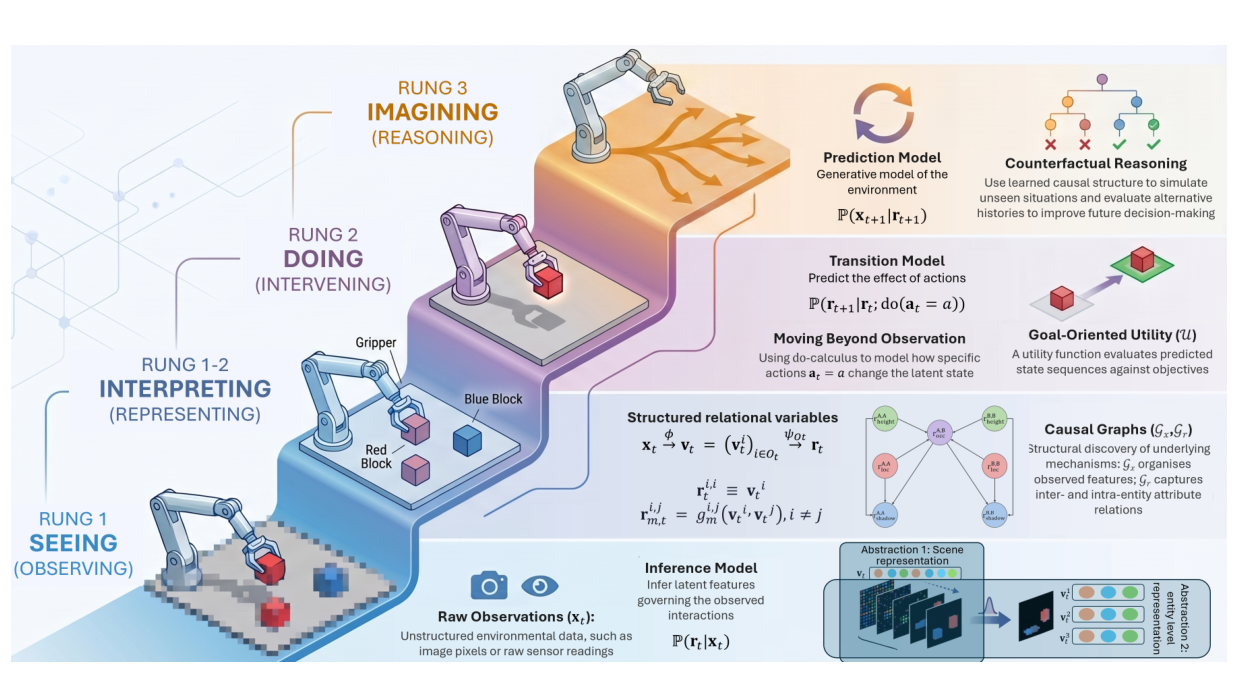
Rung 1: Seeing (Observing)
At the base of the hierarchy, the agent receives high-dimensional, unstructured environmental data $\mathbf{x}_t$ (such as camera video feeds or raw LiDAR point clouds). An Inference Model infers latent state distributions:
\[\mathbb{P}(\mathbf{r}_t \mid \mathbf{x}_t).\]Pure observational statistical models are confined to this rung. They can predict $\mathbb{P}(\mathbf{x}_{t+1} \mid \mathbf{x}_t)$, but cannot distinguish between a cause and an effect.
Rung 1–2: Interpreting (Representing)
To reason about causal interactions, raw pixels must be abstracted into discrete entities. The model performs a two-stage abstraction:
- Entity-level representation: Pixels are mapped into object vectors $\mathbf{v}t = (\mathbf{v}_t^i){i \in \mathcal{O}_t}$ via object-centric learning (e.g. Slot Attention).
- Relational variables: High-level structured representations $\mathbf{r}_t$ encode intra- and inter-entity interactions: \(\mathbf{r}_{m, t}^{i, j} = g_m\left(\mathbf{v}_t^i, \mathbf{v}_t^j\right), \quad i \neq j.\)
- Causal Graphs $(\mathcal{G}_x, \mathcal{G}_r)$: Structure discovery algorithms identify directed edges representing physical dependencies (e.g. “Block A supports Block B”).
Rung 2: Doing (Intervening)
When an agent acts, it is not merely conditioning on a past observation; it is actively altering the generative mechanism via Pearl’s do-operator.
The Transition Model simulates the interventional consequences of action $\mathbf{a}_t = a$:
\[\mathbb{P}\left(\mathbf{r}_{t+1} \mid \mathbf{r}_t; \, \mathrm{do}(\mathbf{a}_t = a)\right).\]By enforcing the Independent Causal Mechanisms (ICM) principle, the model updates only the variables causally affected by the action, guaranteeing that background environment dynamics remain stable. A Goal-Oriented Utility function $\mathcal{U}$ evaluates candidate action trajectories against mission objectives.
Rung 3: Imagining (Reasoning)
At the pinnacle of cognition, the agent engages in Counterfactual Reasoning. Given an observed trajectory $\tau = (\mathbf{x}{1:T}, \mathbf{a}{1:T})$ that led to an undesirable outcome (such as a robotic arm dropping a glass), the agent asks:
“What would have happened if I had gripped the glass 2 centimeters lower?”
Using the structural causal equations:
- Abduction: Infer the unobserved noise terms $\mathbf{u}_{1:T}$ from the actual history.
- Intervention: Apply the hypothetical action $\mathrm{do}(\mathbf{a}_t^*)$.
- Counterfactual Rollout: Simulate the alternative future $\mathbb{P}(\mathbf{x}{t+1} \mid \mathbf{r}{t+1}^*)$ to update policy value functions without repeating mistakes in the physical world.
Why this perspective matters for artificial intelligence
Treating world models as causal systems rather than autoregressive video predictors resolves the critical vulnerabilities of modern model-based reinforcement learning:
- Zero-Shot Transfer: An agent that learns invariant causal mechanisms can adapt instantly when an obstacle is introduced, because the underlying physical laws have not changed.
- Safety Auditing: Trajectory simulations are fully decomposable into directed graph mechanisms, allowing human supervisors to inspect why an agent expects a specific action to succeed.
- Sample Efficiency: Causal abstractions eliminate the need to collect billions of exploratory trial-and-error frames.
Paper and sources
- Avinash Kori and Fabrizio Russo. A Unifying Perspective on Causal World Models: From Observations to Representations to Structure. arXiv:2608.13456 (2026).