
Neuro-argumentative learning: uniting object slots with symbolic logic
In brief
- Deep learning models achieve high accuracy on visual tasks, but their internal decision logic remains opaque and vulnerable to catastrophic reasoning failures.
- Pure symbolic reasoning provides auditable logic, but cannot process unstructured pixel grids directly.
- The Neural Argumentative Learning (NAL) architecture integrates unsupervised Slot Attention with Assumption-Based Argumentation (ABA) to produce verifiable visual decisions.
This retrospective explainer is dated to the June 2025 NeSY conference. It discusses Object-Centric Neuro-Argumentative Learning by Abdul Rahman Jacob, Avinash Kori, Emanuele De Angelis, Ben Glocker, Maurizio Proietti and Francesca Toni.
Consider an automated baggage inspection system at an international airport. The vision system flags a passenger’s suitcase for containing a dangerous prohibited item. When the security officer asks why, a standard neural network can only output a softmax probability: “Class: Threat (94.2%).”
If challenged in a court of law or under safety audits, an opaque probability score is insufficient. A security inspector needs a verifiable, logical chain of evidence: “The suitcase contains an opaque cylindrical container (Object 1), a battery pack with exposed wires (Object 2), and these two items are connected in series without a commercial casing.”
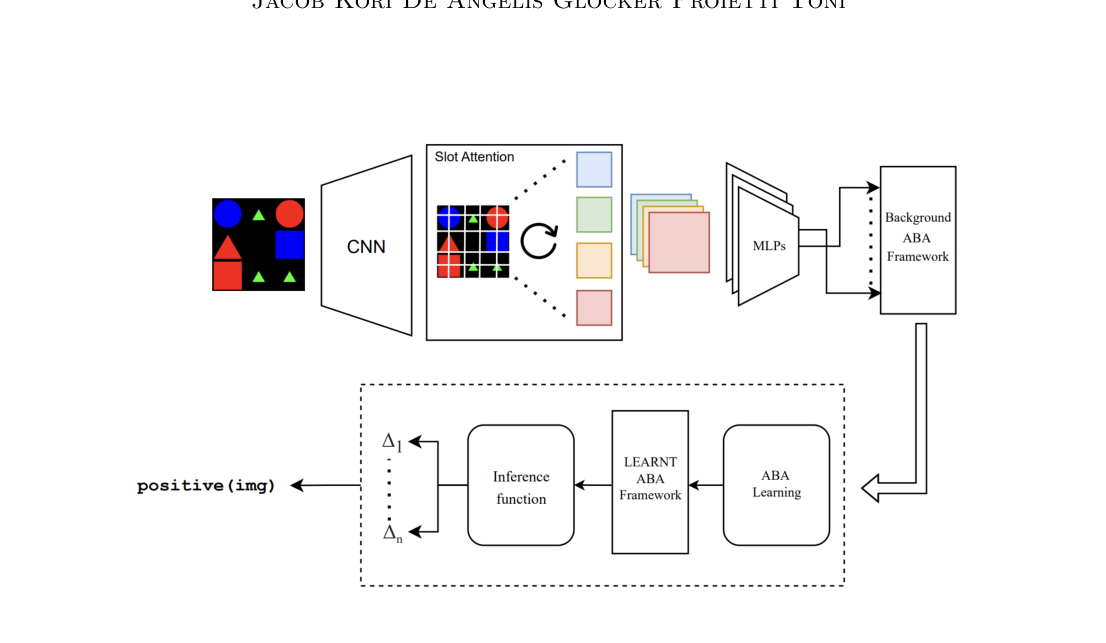
This paper introduces the Neural Argumentative Learning (NAL) architecture, bridging unsupervised neural perception with formal symbolic logic through Assumption-Based Argumentation (ABA).
Why neuro-symbolic integration needs object slots
Past attempts to combine neural networks with logic suffered from a fundamental impedance mismatch:
- Neural networks operate on continuous, dense tensors across a grid of pixels.
- Logic engines operate on discrete symbols, predicates, and relations: $\mathrm{contains}(x, \text{cylinder}) \land \mathrm{adjacent}(x, y)$.
Bounding-box detectors (such as YOLO or Faster R-CNN) require expensive, human-annotated bounding boxes for every training class. Unsupervised Slot Attention, however, decomposes an image into object slots without supervision.
NAL leverages this synergy: the neural component segments and encodes visual entities into facts, while the symbolic component uses those facts to construct an auditable argumentation framework.
The formal machinery of Assumption-Based Argumentation
An Assumption-Based Argumentation (ABA) framework is defined as a 4-tuple:
\[\mathcal{F} = \langle \mathcal{L}, \mathcal{R}, \mathcal{A}, \bar{\cdot} \rangle,\]where:
- $\mathcal{L}$ is a formal language of sentences (atoms).
- $\mathcal{R}$ is a set of deduction rules of the form: \(\alpha \leftarrow \beta_1, \dots, \beta_m \quad (m \ge 0),\) where head $\alpha \in \mathcal{L}$ and body premises $\beta_i \in \mathcal{L}$.
- $\mathcal{A} \subseteq \mathcal{L}$ is a non-empty set of assumptions.
- $\bar{\cdot}: \mathcal{A} \to \mathcal{L}$ is a contrary mapping assigning to each assumption $a \in \mathcal{A}$ its contrary sentence $\bar{a}$.
In NAL, the neural frontend extracts candidate object attributes (e.g., color, shape, relative size) from slots. These attributes populate the body of the rules as grounding facts.
An argument is a formal deduction tree starting from assumptions and facts that proves a conclusion $\alpha$. An argument $A_1$ attacks another argument $A_2$ if the conclusion of $A_1$ matches the contrary of an assumption relied upon by $A_2$.
Resolving queries through non-monotonic semantics
Unlike rigid first-order logic where a single contradiction can break an entire system, ABA supports non-monotonic reasoning: a conclusion holds by default under an assumption, but can be revoked if counter-evidence is discovered.
For example, given a query regarding whether an image contains a target geometric concept:
- The model assumes by default that an object configuration is harmless: $\mathrm{harmless} \in \mathcal{A}$.
- If Slot Attention reveals a red triangle adjacent to a green square: \(\mathrm{rule}_1: \overline{\mathrm{harmless}} \leftarrow \mathrm{slot}_1(\text{red}, \text{triangle}), \mathrm{slot}_2(\text{green}, \text{square}), \mathrm{adjacent}(\mathrm{slot}_1, \mathrm{slot}_2).\)
- The attack succeeds, defeating the harmless assumption and formally proving: $\mathrm{positive}(\text{img})$.
Because every prediction corresponds to an exact dialectical proof tree, safety engineers can trace every single decision back to the specific visual slots and logical rules that justified it.
Paper and sources
- Abdul Rahman Jacob, Avinash Kori, Emanuele De Angelis, Ben Glocker, Maurizio Proietti and Francesca Toni. Object-Centric Neuro-Argumentative Learning. NeSY 2025 / arXiv:2506.14577.