
From Green Bonds to Blue Finance: India, Sovereign Capital, and Sustainable Fisheries
In brief
- From green to blue: Blue bonds build on green-bond issuance and reporting processes, with a specific focus on water and ocean activities.
- India's financing architecture: Sagarmala Finance, municipal water proposals, and the ₹25,000 crore Maritime Development Fund address different parts of the funding need.
- From capital to vessels: Banks and public programmes can aggregate eligible fisheries investments into portfolios that larger investors can finance.
Blue bonds connect capital markets to the sustainable use of oceans and water resources. Their potential extends across fisheries, ports, shipping, aquaculture, water infrastructure, and coastal ecosystems. The central question is how these activities become investable: who raises the money, which projects receive it, and how repayment and environmental performance are assessed.
India makes that question particularly concrete. Sagarmala Finance Corporation is building a dedicated maritime lending business, the government has approved a Maritime Development Fund, and prospective issuers are developing blue-bond frameworks. These developments could connect long-term institutional capital to infrastructure and businesses that have historically depended on public budgets or conventional bank lending.
Green bonds offer a useful precedent: common rules and repeatable financial structures helped a specialised environmental product reach wider investors. Blue finance can use much of that infrastructure while developing its own project pipeline and evidence requirements.
1. From Green Bonds to Blue Bonds
1.1. What the green-bond model contributes
A green bond finances or refinances eligible projects with environmental benefits. Examples include renewable energy, efficient buildings, clean transport, water management, and climate adaptation. ICMA’s Green Bond Principles organise issuance around four components: use of proceeds, project evaluation and selection, management of proceeds, and reporting (ICMA, 2025). Investors can therefore assess both the borrowing proposition and the stated environmental allocation.
The early market illustrates how a focused product can broaden. EIB’s 2007 Climate Awareness Bond directed funds towards renewable energy and energy efficiency (EIB, 2022). IFC’s two US$1 billion benchmark green bonds in 2013 subsequently helped move the market beyond smaller placements towards larger institutional transactions (IFC, 2019).
Blue bonds apply this financing approach to water and ocean objectives. They can be structured within green-bond frameworks, with additional guidance defining the blue activities. The categories overlap: wastewater treatment or sustainable water infrastructure can have both green and blue credentials (ICMA et al., 2023).
| Comparison | Green bonds | Blue bonds |
|---|---|---|
| Environmental scope | Broad environmental objectives, including climate, water, and biodiversity | A focus on sustainable ocean and water activities |
| Typical expenditure | Renewable energy, efficient buildings, clean transport, and other eligible projects | Eligible fisheries, aquaculture, water treatment, coastal restoration, ports, and shipping projects |
| Financing process | Define eligibility, select projects, track proceeds, and report | Use the same process, with water- and marine-specific eligibility and indicators |
| Example evidence | For a renewable-energy project: electricity generated and estimated emissions avoided | For a fisheries project: effort-adjusted bycatch, traceable landings, and resource-management outcomes |
The connection is practical: blue issuers can use established sustainable-bond processes while developing the project selection and measurement needed for their sectors.
1.2. What blue bonds can finance
A blue use-of-proceeds bond raises debt for eligible ocean or water activities. Investors receive the financial rights specified in the bond; the issuer commits to allocating the proceeds within an identified blue-finance framework. Repayment depends on the issuer and transaction structure, while allocation and impact reporting explain the environmental use of funds.
Blue finance also includes loans, equity funds, guarantees, concessional support, and sustainability-linked instruments. A sustainability-linked loan can adjust financial terms against performance targets, whereas a use-of-proceeds blue bond restricts eligible expenditure. These structures can serve complementary purposes (IFC, 2025; ICMA et al., 2023).
Potential applications span several investment needs:
| Activity | Potential financing purpose | Environmental result to assess |
|---|---|---|
| Fisheries and seafood supply chains | Selective gear, eligible monitoring, traceability, and cold-chain improvements | Sustainable resource use, reduced unwanted catch, and lower losses |
| Ports and shipping | Eligible pollution controls, wastewater reception, and cleaner operations | Reduced pollution and improved environmental performance |
| Water and wastewater | Treatment, reuse, and infrastructure improvements | Better water security and reduced contamination |
| Coastal ecosystems | Mangrove restoration, habitat protection, and resilience projects | Ecosystem condition and protection of coastal communities |
| Aquaculture | Eligible improvements in production systems | Reduced nutrient impacts and more sustainable production |
These are investment pathways to assess, rather than automatic eligibility for every asset in a sector. Project selection must follow the applicable framework and safeguards. IFC’s guidance covers both freshwater and ocean activities, while the joint practitioner’s guide focuses on the sustainable blue economy (IFC, 2025; ICMA et al., 2023).
2. From Sovereign Pilots to Institutional Blue Capital
2.1. Sovereign issues established a financing route
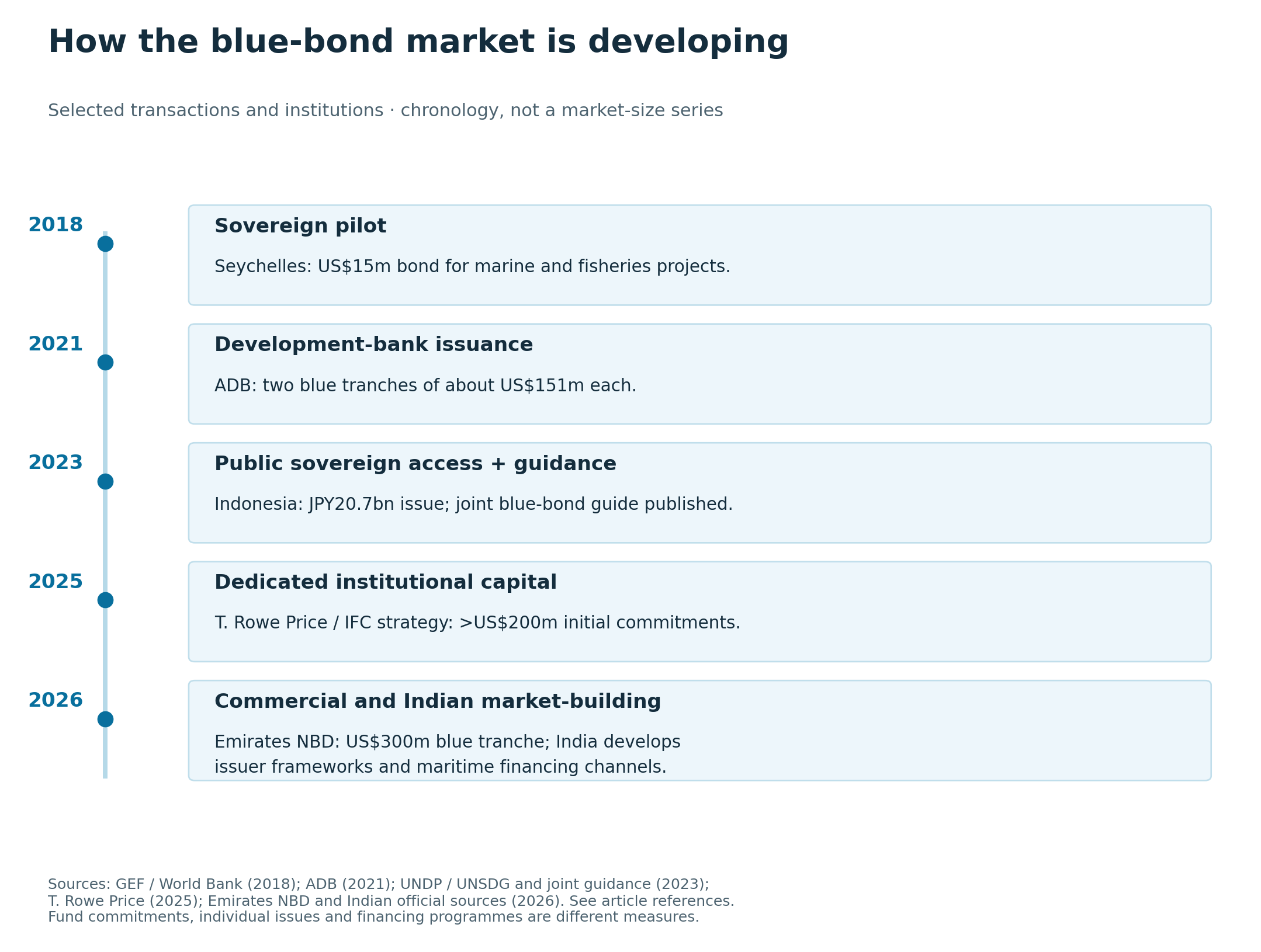
Seychelles issued the world’s first sovereign blue bond in 2018, raising US$15 million for sustainable marine and fisheries projects. A US$5 million World Bank guarantee and US$5 million concessional GEF loan supported the transaction (GEF, 2018). This showed how public credit support could help connect investors to a country’s ocean-management programme.
Indonesia broadened sovereign access in May 2023 with a JPY20.7 billion, approximately US$150 million, blue-bond issue in Japan. UNDP described it as the first publicly offered sovereign blue bond aligned with ICMA principles. Its intended uses included coastal protection, fisheries and aquaculture management, biodiversity, and mangrove rehabilitation (UNDP/UNSDG, 2023).
These examples illustrate different issuance settings. The Seychelles pilot used a supported sovereign placement; Indonesia accessed a public foreign debt market. Both linked national financing to defined blue-economy objectives.
2.2. Development banks and commercial institutions widened the market
ADB’s September 2021 blue issuance comprised A$208 million and NZ$217 million, each approximately US$151 million at issuance. Its framework included fisheries, aquaculture, ecosystem restoration, marine renewable energy, pollution reduction, ports, and shipping (ADB, 2021). Development-bank issuance provides investors with an institutional route into a portfolio of eligible projects.
Commercial-bank transactions extend that approach through lending books. In January 2026, Emirates NBD announced US$300 million of blue bonds alongside a separate US$700 million green tranche (Emirates NBD, 2026). A bank can raise capital centrally and allocate it to eligible loans, allowing smaller projects to participate without issuing their own bonds.
2.3. Dedicated investors are beginning to organise around blue assets
On 15 September 2025, T. Rowe Price and IFC launched their Emerging Markets Blue Economy Bond Strategy with more than US$200 million in initial commitments (T. Rowe Price, 2025). The institutional parallel with green bonds is the creation of investable portfolios: investors gain a managed route into eligible assets instead of assessing every underlying project independently. A dedicated strategy can bring portfolio selection, project assessment, and reporting expertise into the market. The committed amount describes investment capital for the strategy, rather than bonds already issued or money already spent by projects.
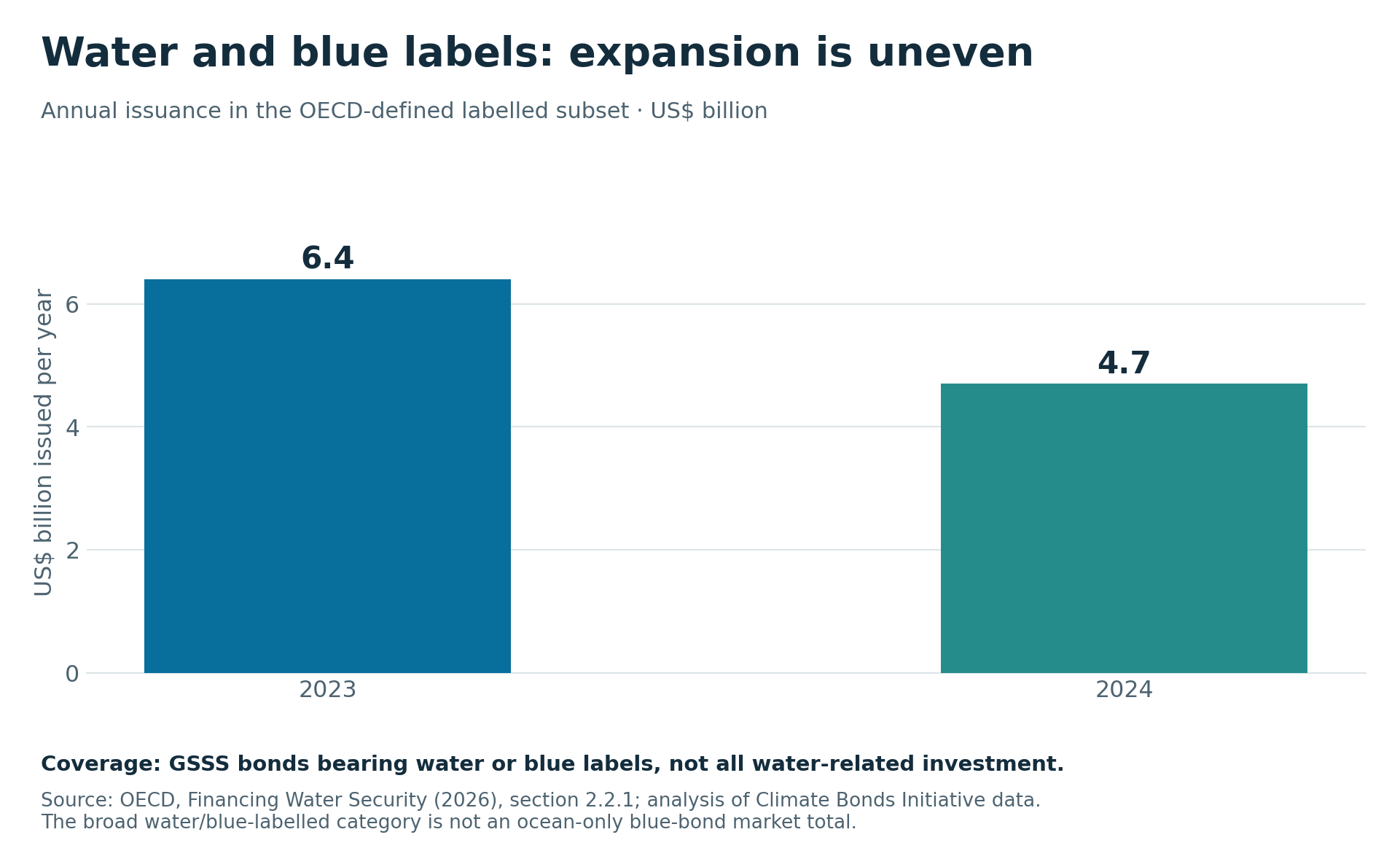
The available market data also cautions against assuming uninterrupted growth. OECD’s analysis records US$6.4 billion in 2023 and US$4.7 billion in 2024 of sustainable bonds bearing water or blue labels (OECD, 2026). That category includes water-labelled instruments and should not be interpreted as an ocean-only blue-bond total.
3. Sovereign Bonds, Public Funds, and Sovereign Investors
Several types of public involvement can support blue finance, each with a different role in the transaction.
| Financing channel | Who provides or raises capital? | Role in blue finance |
|---|---|---|
| Sovereign blue bond | A national government borrows from bond investors | Funds eligible expenditure under a sovereign framework |
| Public-sector lender’s blue bond | A government-owned financial institution borrows | Supports eligible lending on the institution’s balance sheet |
| Public development fund | Government and other contributors capitalise a managed vehicle | Provides equity, concessional support, or another defined form of finance |
| Sovereign wealth fund investment | A state-owned investment institution invests capital | Can supply equity or buy debt where its mandate permits |
| Guarantee or risk-sharing support | A government or development institution assumes defined risks | Can improve financing terms or make a transaction feasible |
Seychelles and Indonesia provide sovereign blue-bond examples. A bond issued by Sagarmala Finance would instead be borrowing by a public-sector company; government ownership alone does not turn it into a Government of India sovereign bond. Similarly, a maritime development fund has an investment or policy mandate, while a sovereign wealth fund acts as an investor.
For project developers, these channels can fit together. Public capital may support project preparation or absorb specified risks, equity investors can finance development, and lenders can provide debt once the project has a viable repayment structure. Blue bonds become one way of funding that debt within a larger financing arrangement.
4. India: Sagarmala Finance and Domestic Blue-Bond Development
4.1. A regulatory category already exists
SEBI’s February 2023 amendments introduced blue bonds within the definition of green debt securities. The specified scope includes sustainable water management, shipping, fishing, fully traceable sustainable seafood, ocean energy, and ocean mapping (SEBI, 2023). This gives Indian issuers a recognised category for water and marine financing, including a direct connection to seafood operations.
Domestic demand can also extend beyond coastal infrastructure. Vadodara Municipal Corporation’s 2024–25 annual report set out a ₹200 crore blue municipal bond proposal for water infrastructure and long-term water security (VMC, 2024–25). That is a stated fundraising plan, rather than confirmation of a completed issue.
4.2. Sagarmala connects a project pipeline to long-term borrowing
The Sagarmala Programme supports port-led development, connectivity, coastal communities, shipping, and inland waterways (MoPSW/PIB, 2026a). Sagarmala Finance Corporation Limited (SMFCL) provides a dedicated financing institution within that wider maritime ecosystem.
The reason for exploring bonds is partly about funding duration. In a May 2026 interview, SMFCL’s managing director described average lending tenors of around 12 years, compared with approximately 3.5 years for its existing term borrowings. Longer-term bonds could reduce that mismatch and diversify funding sources (Reuters, 2026). This is the financing issue also illustrated in the Drishti IAS explainer, around 7:41.
SMFCL’s published capital strategy identifies an approved ₹25,000 crore borrowing programme, mobilisation through several funding channels, and a medium-term lending expansion (SMFCL, n.d.). That borrowing authority covers its wider financing business and should not be treated as a completed blue-bond issue.
4.3. Lending has begun; bond mobilisation remains a separate measure
The Ministry’s 23 October 2026 update reports ₹11,563 crore sanctioned and ₹5,107 crore disbursed as of 30 September. It identifies an ambition of ₹60,205 crore in cumulative disbursements by end-FY2031, conditional on capital support (MoPSW/PIB, 2026b; SMFCL, n.d.). Sanctions represent approved lending; disbursements track money released to projects.
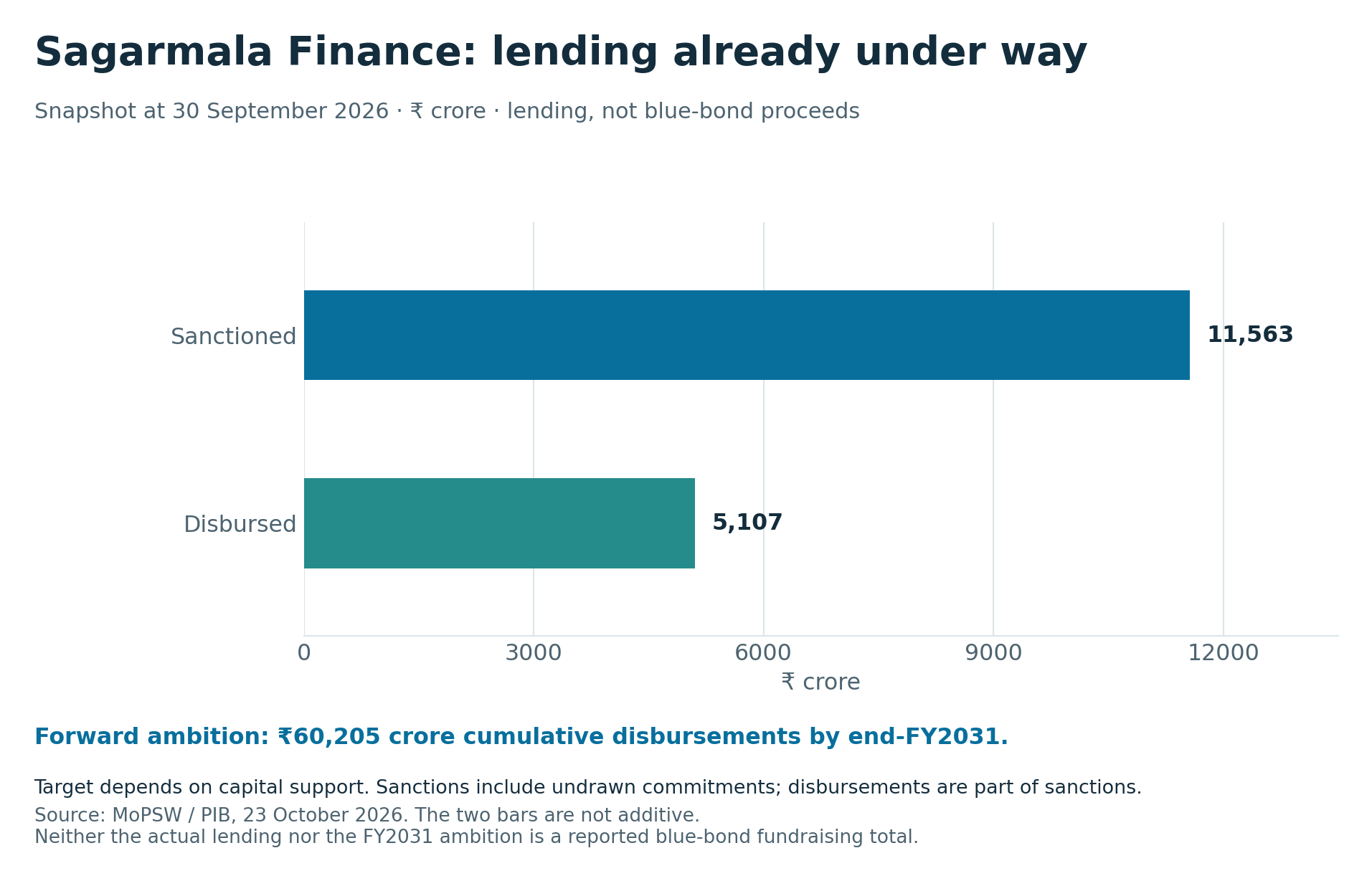
The bond-market record needs to be read separately. SMFCL publishes a blue-bond framework and second-party opinion on its website (SMFCL, n.d.). However, Business Standard reported that its proposed ₹600 crore, ten-year blue-bond offer was withdrawn on 28 September 2026, following a gap between investor bids and the issuer’s preferred borrowing cost (Panda, 2026). That particular offer cannot be counted as money raised.
India’s opportunity therefore includes both the demand for maritime finance and the work of converting that demand into transactions at acceptable prices. Project need, regulatory eligibility, credit quality, tenor, and investor appetite all have to align.
5. The Maritime Development Fund and Sovereign Capital
5.1. The ₹25,000 crore public financing structure
The Union Cabinet approved the ₹25,000 crore Maritime Development Fund (MDF) in September 2025. It comprises a ₹20,000 crore Maritime Investment Fund (MIF) and a ₹5,000 crore Interest Incentivization Fund (IIF) (MoPSW/PIB, 2025). These are components of the same corpus.
The MIF guidelines provide for ₹9,800 crore of Government of India committed capital, representing 49% of the target corpus. The remaining ₹10,200 crore is to be mobilised from other eligible contributors, including sovereign wealth funds, commercial and institutional investors, funds of funds, and major ports (MoPSW, 2026). This is a structure for mobilising public and institutional capital, rather than an announcement that all contributions have been received.
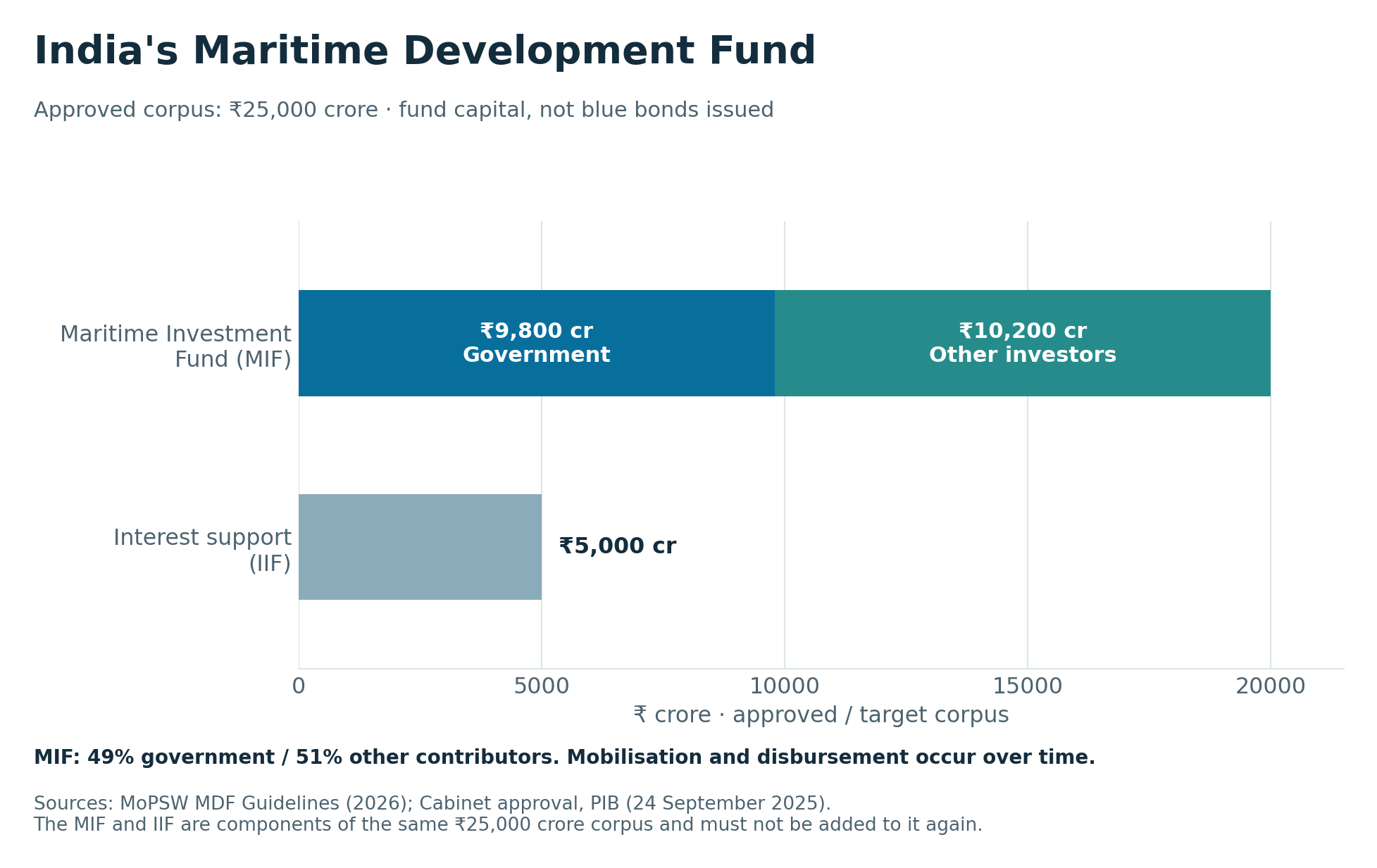
The guidelines allow concessional government participation to help attract commercial capital through differentiated return or loss-sharing arrangements. This addresses a different constraint from bond issuance: whether projects can secure suitable equity and risk-bearing capital before or alongside debt.
Implementation is proceeding in stages. The October 2026 government update named SBI Ventures as MIF fund manager and targeted a ₹5,000 crore first close by January 2027 (MoPSW/PIB, 2026b). The distinction between an approved corpus and a fund close matters when assessing how much capital is available to invest.
5.2. Where sovereign wealth funds fit
Sovereign wealth funds can participate as investors in eligible vehicles; they need not be issuers of blue bonds. The MIF’s express inclusion of these investors provides a route for sovereign capital into India’s maritime sector, subject to actual commitments and the fund’s investment decisions (MoPSW, 2026).
India already has relevant infrastructure-investment experience. The Finance Ministry documented a subsidiary of the Abu Dhabi Investment Authority participating in NIIF’s first Master Fund close in 2017, followed by NIIF’s partnership with DP World for a ports and logistics investment platform in 2018 (Ministry of Finance/PIB, 2018). This demonstrates a channel connecting sovereign-backed capital, domestic institutions, and maritime assets. It is evidence of infrastructure investment, rather than a dedicated blue-bond allocation.
For blue finance, such platforms offer a practical institutional precedent. The additional task is to identify eligible activities within portfolios and connect financing to reportable water or marine benefits. Broader maritime funds and port investments should therefore be assessed at project level before being included in blue-finance totals.
6. Connecting Blue Capital to Fisheries and Vessel Owners
A fishing-vessel owner is unlikely to access institutional bond markets directly. A bank, development institution, or public programme can aggregate eligible investments across vessels and seafood businesses, turning many smaller financing needs into a portfolio. A proposed structure is:
Institutional investors → blue bond or investment vehicle → lender or programme → eligible fisheries loans → verified expenditure and results.
The Seychelles transaction demonstrated part of this architecture through grants for fisheries management and loans supporting sustainable fishing and ocean-resource protection (World Bank, 2021). India’s regulatory recognition of sustainable fishing and traceable seafood provides a basis for considering similar pathways within domestic financing frameworks (SEBI, 2023).
| Potential fisheries investment | Financing rationale | Evidence required |
|---|---|---|
| Selective gear | Spread the upfront cost of changing fishing practice | Comparable bycatch observations, adjusted for effort |
| Electronic monitoring and logbooks | Fund observation and reporting capability | Usable recording coverage, independent review, and reconciliation |
| Catch identification and traceability | Maintain links from vessel and trip to landing and buyer | Verified catch, species, vessel, and transaction records |
| Refrigeration and handling | Improve the use of landed catch | Product-loss baselines, energy use, and measured changes |
| Eligible energy-system upgrades | Reduce operating costs and emissions | Fuel and emissions measurements alongside total fishing effort |
These are proposed applications, not claims that an existing Indian bond or fund has financed each category. Eligibility must also account for the fishery itself. An upgrade that lowers fuel use per tonne can still increase total pressure if it enables substantially more fishing.
In our companion post, Trip Sampling Doctrine, we examined how observation and human verification interact. The same distinction matters in financing. Installation records establish that equipment was purchased; operational records establish whether it was used; environmental assessment tests whether the intended result followed.
Finance programmes should establish baselines before investment and fund verification alongside equipment. For lenders, that evidence can support programme reporting and assessment of operating performance. Whether it translates into lower financing costs depends on the borrower’s credit, transaction structure, and market conditions.
7. Where Blue Finance Stands Now
As of November 2026, blue finance has moved beyond isolated sovereign pilots into a market with shared guidance, public sovereign and bank issues, and dedicated investment strategies. India’s developments add domestic regulation, a specialised maritime lender, proposed municipal water finance, and a public investment-fund structure to that picture.
Green bonds provide a precedent for how blue finance might deepen: credible issuers and common rules support repeat transactions, while banks and investment funds aggregate smaller projects into portfolios. Blue finance adds sector-specific questions, including how water quality, ecosystem condition, and fishing pressure should be measured. Its progress should be assessed through completed transactions and credible project results; green bonds’ growth does not establish a timetable for blue bonds (ICMA, 2025; ICMA et al., 2023).
For India, the next tests are concrete: completing fund mobilisation, placing bonds on workable terms, preparing eligible projects, and demonstrating how funds reach them. For fisheries, the task is to connect those financial channels to measurable improvements in resource use, reporting, and vessel operations. That is how a broad maritime investment programme can develop a credible role in blue finance.
References and Standards
- European Investment Bank (2022). 15 years on, green, social and sustainability bonds are still the future of sustainable finance. Account of the 2007 Climate Awareness Bond.
- International Finance Corporation (2019). IFC Crosses $10 Billion Threshold for Green Bond Issuance. 19 September 2019; includes the 2013 benchmark green-bond issues.
- International Finance Corporation (2025). Guidelines for Blue Finance, Version 2.0. September 2025.
- ICMA, IFC, ADB, UNEP FI, and UN Global Compact (2023). Bonds to Finance the Sustainable Blue Economy: A Practitioner’s Guide. Joint publication announcement and scope, 6 September 2023.
- Global Environment Facility (2018). Seychelles launches World’s First Sovereign Blue Bond. Joint launch announcement, 29 October 2018.
- UNDP/UN Sustainable Development Group (2023). Indonesia Launches the World’s First Publicly Offered Sovereign Blue Bond. 13 July 2023.
- Asian Development Bank (2021). ADB Issues First Blue Bond for Ocean Investments. 10 September 2021.
- Emirates NBD (2026). Emirates NBD Completes Landmark Dual-Tranche Blue-Green Bond Transaction. 8 January 2026.
- T. Rowe Price (2025). T. Rowe Price Launches Blue Bond Emerging Markets Strategy. 15 September 2025.
- OECD (2026). Leveraging bond finance for water investments. Chapter 2 of Financing Water Security, 9 July 2026; section 2.2.1.
- Securities and Exchange Board of India (2023). Issue and Listing of Non-Convertible Securities (Amendment) Regulations, 2023. Gazette notification, 2 February 2023; definition of green debt security, subclause (x).
- Vadodara Municipal Corporation (2024–25). Annual Report: Commissioner’s Report. Blue municipal bond proposal, p. 26.
- Ministry of Ports, Shipping and Waterways / PIB (2026a). Sagarmala: Transforming India’s Maritime Landscape. 11 April 2026.
- Reuters (2026). India’s First Blue Bond Launch: Sagarmala Sets Sail for Sustainable Financing. Published by ETInfra, 30 May 2026; interview on planned financing and maturity mismatch.
- Drishti IAS English (2026). What Are Blue Bonds? India’s First Blue Bonds Explained. Video, 21 August 2026; slide around 7:41 on asset–liability matching.
- Sagarmala Finance Corporation (n.d.). Financial Performance and Growth. Published borrowing programme and capital strategy; accessed 8 November 2026.
- Ministry of Ports, Shipping and Waterways / PIB (2026b). India’s First Maritime NBFC SMFCL Scales up with ₹5,107 crore Disbursed, Aims for ₹60,205 crore by 2031. 23 October 2026.
- Sagarmala Finance Corporation (n.d.). Policies: Blue Bond Framework and Second Party Opinion. Accessed 8 November 2026.
- Panda, S. (2026). Sagarmala Finance withdraws ₹600 crore blue bond issue on higher coupon. Business Standard, 28 September 2026.
- Ministry of Ports, Shipping and Waterways / PIB (2025). Comprehensive 4-Pillar Approach to Strengthen Shipbuilding, Maritime Financing, and Domestic Capacity. Cabinet package, 24 September 2025.
- Ministry of Ports, Shipping and Waterways (2026). Maritime Development Fund Guidelines. Fund structure, government commitment, fundraising, and eligible contributors.
- Ministry of Finance / PIB (2018). NIIF makes its first investment: partnership with DP World for ports and logistics. 22 January 2018.
- World Bank (2021). Small States: Supporting Sustainable Development. Seychelles blue-bond grants and loans.
- International Capital Market Association (2025). Green Bond Principles. Voluntary process guidelines, June 2025.