
Free Argumentative Exchanges: multi-agent debates for visual explanations
In brief
- Explaining opaque deep vision models requires transparent, structured reasoning rather than static pixel heatmaps.
- Free Argumentative Exchanges (FAXs) allow two competing agents to exchange arguments and internalise new evidence differently than originally stated.
- The interaction is governed by Bipolar Argumentation Frameworks (BAFs) and quantified using consensus and persuasion rates.
This retrospective explainer is dated to the February 2025 AAMAS publication. It discusses Free Argumentative Exchanges for Explaining Image Classifiers by Avinash Kori, Antonio Rago and Francesca Toni.
Consider an art appraiser and an antique collector examining an old painting to decide whether it is an authentic Renaissance original or a 19th-century imitation. The appraiser points out the craquelure pattern in the varnish, arguing it matches 16th-century Italian methods. The collector counters that the blue pigment contains Prussian blue, a synthetic compound invented in 1704. In response, the appraiser acknowledges the pigment but argues it was added during a later conservation effort.
Neither specialist communicates by handing the other a highlighted photograph. They exchange structured arguments that cite specific visual features, interpret them through private domain expertise, and update their beliefs until one perspective prevails or a consensus is reached.
This paper formalises that dialectical process for deep learning as Free Argumentative Exchanges (FAXs), a multi-agent framework that explains image classifiers through principled argumentative dialogues.
From static attributions to Bipolar Argumentation
Most visual explanation methods output a single saliency map or feature attribution vector. Saliency maps suffer from two major flaws:
- Unilateral perspective: They display features that support the winning prediction, completely ignoring features that argued against it or supported a plausible runner-up.
- Fixed interpretation: They assume that every visual feature has an unambiguous, unmodifiable meaning.
FAXs solve this by modeling explanations through Bipolar Argumentation Frameworks (BAFs). A BAF is a tuple:
\[\mathrm{BAF} = \langle \mathcal{A}, \mathcal{R}_{\text{att}}, \mathcal{R}_{\text{supp}} \rangle,\]where $\mathcal{A}$ is a finite set of arguments, $\mathcal{R}{\text{att}} \subseteq \mathcal{A} \times \mathcal{A}$ is an attack relation, and $\mathcal{R}{\text{supp}} \subseteq \mathcal{A} \times \mathcal{A}$ is a support relation.
In FAX, two agents $\mathcal{A}^1$ and $\mathcal{A}^2$ argue about the classification of an image $x$. Each agent maintains a private BAF representing its personal interpretation of the evidence, and contributes claims to a shared Exchange BAF.
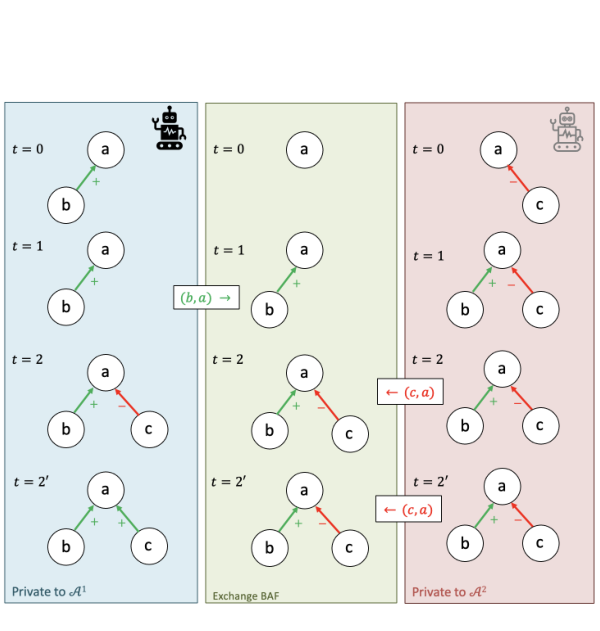
The mechanics of exchange and internalisation
At step $t=0$, each agent inspects the classifier’s latent representations and formulates an initial stance:
- Agent $\mathcal{A}^1$ advocates for class $c_1$ using argument $a$, supported by sub-argument $b$ ($(b, a) \in \mathcal{R}_{\text{supp}}^1$).
- Agent $\mathcal{A}^2$ challenges claim $a$ by introducing argument $c$, which attacks $a$ ($(c, a) \in \mathcal{R}_{\text{att}}^2$).
Crucially, in a Free Argumentative Exchange, an agent is not forced to adopt the opponent’s argument verbatim. When $\mathcal{A}^2$ introduces $(c, a)$ as an attack, $\mathcal{A}^1$ may internalise $c$ as an attack, as a support, or even discover that $c$ reinforces its own position under an alternative interpretation (shown at step $t=2’$ in the figure where $\mathcal{A}^1$ interprets $c$ positively).
The dialectical strength of any argument $a \in \mathcal{A}$ is evaluated using gradual semantics:
\[\sigma(a) = f\left(\tau(a), \bigoplus_{s \in \mathrm{Supp}(a)} \sigma(s), \bigoplus_{k \in \mathrm{Att}(a)} \sigma(k)\right),\]where $\tau(a) \in [0, 1]$ is the base score of the visual feature, $\mathrm{Supp}(a)$ are supporting arguments, $\mathrm{Att}(a)$ are attacking arguments, and $\oplus$ is an aggregation operator.
Evaluating conversational explanations: consensus and persuasion
To measure how well an argumentative dialogue explains a decision, the paper defines two quantitative metrics:
- Consensus Rate: The fraction of debates where both agents converge on the same final winning class, demonstrating that the visual evidence was compelling enough to resolve conflict: \(\mathrm{Consensus} = \mathbb{I}\left(\arg\max_{c} \sigma_{\mathcal{A}^1}(c) = \arg\max_{c} \sigma_{\mathcal{A}^2}(c)\right).\)
- Persuasion Rate: The frequency with which an agent that initially backed a minority class is persuaded to switch its stance after receiving counter-arguments from the opposing agent.
Empirical experiments across multi-class vision benchmarks demonstrate that FAXs produce explanations that are significantly more faithful to the underlying classifier’s internal reasoning than traditional gradient heatmaps, while providing human users with an interactive, auditable dialogue.
Paper and sources
- Avinash Kori, Antonio Rago and Francesca Toni. Free Argumentative Exchanges for Explaining Image Classifiers. AAMAS 2025 / arXiv:2502.12995.