
Object-centric case-based reasoning via argumentation
In brief
- Case-Based Reasoning (CBR) solves new queries by finding similar past precedent cases, mirroring human analogical reasoning.
- Traditional CBR requires hand-crafted tabular features and struggles with raw image pixels.
- Slot Attention Argumentation for Case-Based Reasoning (SAA-CBR) extracts object representations and evaluates classification through formal dialectical disputes between precedent cases.
This retrospective explainer is dated to the September 2025 ArgXAI workshop at ECAI. It discusses Object-Centric Case-Based Reasoning via Argumentation by Gabriel de Olim Gaul, Adam Gould, Avinash Kori and Francesca Toni.
In the common law legal system, a judge rarely decides a novel lawsuit by evaluating an abstract mathematical formula. Instead, attorneys present precedent cases:
- “Your Honour, in Smith v. Jones, the court ruled in favor of the plaintiff because Condition A and Condition B were present.”
- The opposing counsel responds: “Yes, but in Miller v. Davis, the court distinguished that precedent: Condition C was also present, which attacked and overturned the finding of liability.”
This process is known as Case-Based Reasoning (CBR). It is one of the most transparent and human-aligned forms of reasoning because every decision is justified by pointing directly to concrete historical examples and explaining how they compare to the current scenario.
However, applying CBR to computer vision has historically been difficult because images are continuous grids of pixels, not neat collections of legal facts.
This paper introduces Slot Attention Argumentation for Case-Based Reasoning (SAA-CBR), uniting unsupervised object discovery with dialectical argumentation over past visual cases.
The SAA-CBR architecture
SAA-CBR solves the vision-to-logic bottleneck by decomposing an image into unsupervised object slots before feeding them into an Abstract Argumentation for Case-Based Reasoning (AA-CBR) engine:
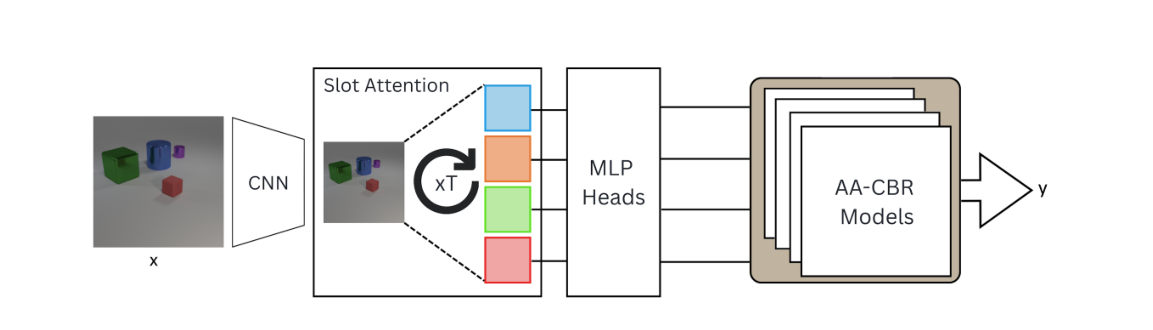
- Neural Component: A convolutional backbone followed by Slot Attention decomposes image $x$ into $K$ object slots. Lightweight MLP projection heads translate slot embeddings into discrete categorical properties (e.g. object count, color, geometry).
- Symbolic Component: The extracted features are treated as the feature set $F(q)$ of the new query image $q$. The system consults a casebase $\mathcal{CB}$ of stored training examples to determine the winning label.
The dialectical mechanics of AA-CBR
In AA-CBR, a case $c$ is a pair:
\[c = \left(F(c), y(c)\right),\]where $F(c)$ is the set of features exhibited by case $c$, and $y(c) \in \mathcal{Y}$ is its class label.
Given a new unlabelled query image $q$ with features $F(q)$, a stored case $c_1 \in \mathcal{CB}$ argues that $q$ should receive label $y(c_1)$ based on their shared features. However, another stored case $c_2 \in \mathcal{CB}$ can attack $c_1$ if:
- $c_2$ is more specific or more similar to query $q$ than $c_1$ under a partial order: \(c_2 \succ_q c_1 \iff \left(F(c_1) \cap F(q)\right) \subset \left(F(c_2) \cap F(q)\right).\)
- $c_2$ predicts an opposing outcome: \(y(c_2) \neq y(c_1).\)
The attack relation defines an argumentation framework:
\[\mathcal{AF}_q = \langle \mathcal{CB} \cup \{c_0\}, \mathcal{R}_{\text{att}} \rangle,\]where $c_0 = (\emptyset, y_0)$ is a default base assumption. The query is classified by computing the grounded extension—the unique, unambiguous set of unattacked or successfully defended arguments.
Novel extensions: partial orders and bipolar support
The paper introduces several key technical innovations to scale AA-CBR to complex visual reasoning:
- Count-Based Partial Orders: Standard AA-CBR relies on binary set inclusion ($F_1 \subset F_2$). SAA-CBR develops count-sensitive partial orders capable of reasoning about object cardinality (e.g., “contains at least three red cylinders”).
- Casebase Reduction: By clustering slot features and selecting representative prototype cases, the size of the casebase is compressed by over 80% without sacrificing predictive accuracy.
- Supported AA-CBR (Bipolar Reasoning): Incorporating positive support relations where similar past cases reinforce each other’s evidentiary weight, making the dispute graph more resilient to noise.
On the CLEVR-Hans benchmark—a rigorous diagnostic dataset designed to expose shortcut learning in neural networks—SAA-CBR achieves classification accuracy competitive with black-box vision models while providing complete dialectical dispute trees justifying every prediction.
Paper and sources
- Gabriel de Olim Gaul, Adam Gould, Avinash Kori and Francesca Toni. Object-Centric Case-Based Reasoning via Argumentation. ArgXAI @ ECAI 2025 / arXiv:2510.00185.