
Transparent visual reasoning via object-centric agent negotiation
In brief
- Popular post-hoc explainability methods like Grad-CAM and LIME produce fuzzy pixel heatmaps that are easily fooled and fail to explain the true decision logic.
- OCEAN (Object-Centric Explananda via Agent Negotiation) replaces post-hoc heatmaps with an inherently interpretable multi-agent negotiation process.
- Agents evaluate object slots through a cooperative game, negotiating on the minimal, coherent set of objects needed to justify the prediction.
This retrospective explainer is dated to the September 2025 preprint release. It discusses Transparent Visual Reasoning via Object-Centric Agent Collaboration by Benjamin Teoh, Ben Glocker, Francesca Toni and Avinash Kori.
Suppose a jury is tasked with evaluating security footage to determine whether a complex event occurred—say, an illegal handoff between two individuals on a crowded subway platform.
A juror who simply circles half the screen with a red marker has not explained anything. A credible explanation requires isolating the specific objects that matter: the blue briefcase carried by Person A, the black gloves worn by Person B, and the physical exchange between them, while dismissing the innocent bystanders standing three feet away.
In explainable AI, most computer vision techniques act like the juror with the red marker. Saliency maps smear highlight colors across pixels without identifying which discrete physical components were necessary or sufficient for the decision.
OCEAN (Object-Centric Explananda via Agent Negotiation) reframes visual classification as a game-theoretic collaboration between multiple autonomous agents who negotiate over discrete object components to build an auditable explanandum.
Why post-hoc explanations fall short
Post-hoc explainability methods (Grad-CAM, Integrated Gradients, LIME) suffer from three fatal flaws:
- Unfaithfulness: The heatmap is generated after the black-box model has already made its decision; it often highlights features that had no causal influence on the output logit.
- Concept ambiguity: A glowing blob on an image does not explain what concept is detected (is it the shape, the texture, the color, or the background context?).
- No minimality: Standard heatmaps cannot tell a user which objects could be removed without changing the decision.
OCEAN solves this by building an inherently interpretable architecture that makes decisions through negotiation over object slots.
The classification game: agents negotiating over slots
The input image $\mathbf{x}$ is first parsed by an unsupervised object-centric encoder into $K$ object slots $O_1, \dots, O_K$.
Instead of feeding all slots into a monolithic multi-layer perceptron, OCEAN initiates a Classification Game played by $M$ specialized explaining agents $\mathcal{A}_1, \dots, \mathcal{A}_M$:
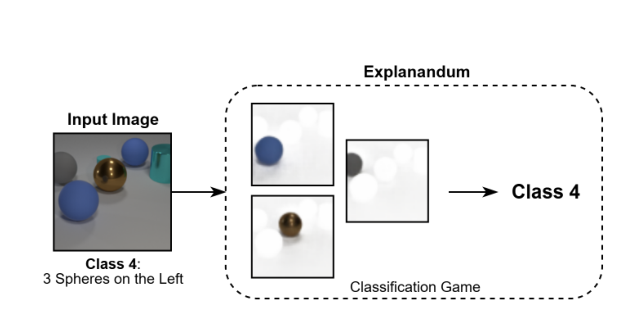
Each agent $\mathcal{A}_i$ selects a candidate subset of object slots $S_i \subseteq {O_1, \dots, O_K}$ and evaluates its evidentiary utility:
\[U_i(S_i, c) = \mathrm{Fidelity}(S_i, c) - \lambda \, |S_i|,\]where:
- $\mathrm{Fidelity}(S_i, c)$ measures how strongly the selected objects $S_i$ support target class $c$ over all other classes.
-
$\lambda S_i $ is a parsimony penalty that penalises selecting superfluous objects (Occam’s razor).
The agents communicate through a round-robin proposal protocol. If Agent 1 proposes that the presence of the blue sphere alone justifies Class 4, Agent 2 can challenge this by proving that a brown sphere and a grey sphere are also required to distinguish Class 4 from Class 2.
The negotiation terminates when agents achieve consensus on a Pareto-optimal explanandum $S^*$:
\[S^* = \arg\max_{S \subseteq \{O_1, \dots, O_K\}} \sum_{i=1}^M U_i(S, c^*), \quad c^* = \arg\max_{c} p(c \mid S^*).\]Human trust and empirical validation
The authors benchmarked OCEAN against both standard black-box vision backbones and popular explanation tools (Grad-CAM, LIME) across diagnostic multi-object environments:
- Competitive Accuracy: Despite its strict transparency constraints, OCEAN matches the classification accuracy of unconstrained black-box models.
- Strict Faithfulness: Because predictions are generated directly from the negotiated slot subset $S^*$, masking out non-selected slots results in 0% change to the output logits.
- User Study Ratings: In blinded human user evaluations, participants consistently rated OCEAN’s object-level evidence as significantly more intuitive, trustworthy, and actionable than traditional pixel heatmaps.
Paper and sources
- Benjamin Teoh, Ben Glocker, Francesca Toni and Avinash Kori. Transparent Visual Reasoning via Object-Centric Agent Collaboration. arXiv:2509.23757 (2025).